50 MM HOLE SPACING

Closer hole spacing16 mm system
- S355 steel, 6 mm thick plate
- Adjustable legs made from 80 × 80 mm sections
- Working height 870 to 1 000 mm
Modular welding tables with a 16 mm system. Choose the hole spacing, size and accessories to suit your workshop.

Two hole spacing options with the same clamping system. Find sizes and the current range in the mateos.sk shop.

Compare the published specifications of individual tables. Always check the current size, variant and price on the product page in the online shop.
Tables with 100 mm hole spacing are available from Mateos. The wider spacing suits applications where coarser positioning of parts is sufficient.
Tables with 50 mm hole spacing offer more clamping points and more precise fixture positioning to suit the size of the parts.
Series names are used inconsistently in older materials. When ordering, the technical specification of the selected product is decisive, particularly hole spacing, size and plate thickness.
The perforated work surface helps position parts repeatedly. Adjustable legs allow the workstation height to be adapted.
Stops, angle brackets, positioners and clamps extend the possibilities of your welding table.
View accessories
An example of a MAWELD table in a workshop environment. The 16 mm system allows the tabletop to be combined with stops, angle brackets and clamps.
We do not identify the specific model, size or customer in this published photograph because these details have not been confirmed.
Ask about a suitable setup ↗MAWELD focuses on workbenches and accessories for welding workshops. The current product range and orders are handled by the Mateos.sk online shop.
One table. Endless possibilities for industrial use.
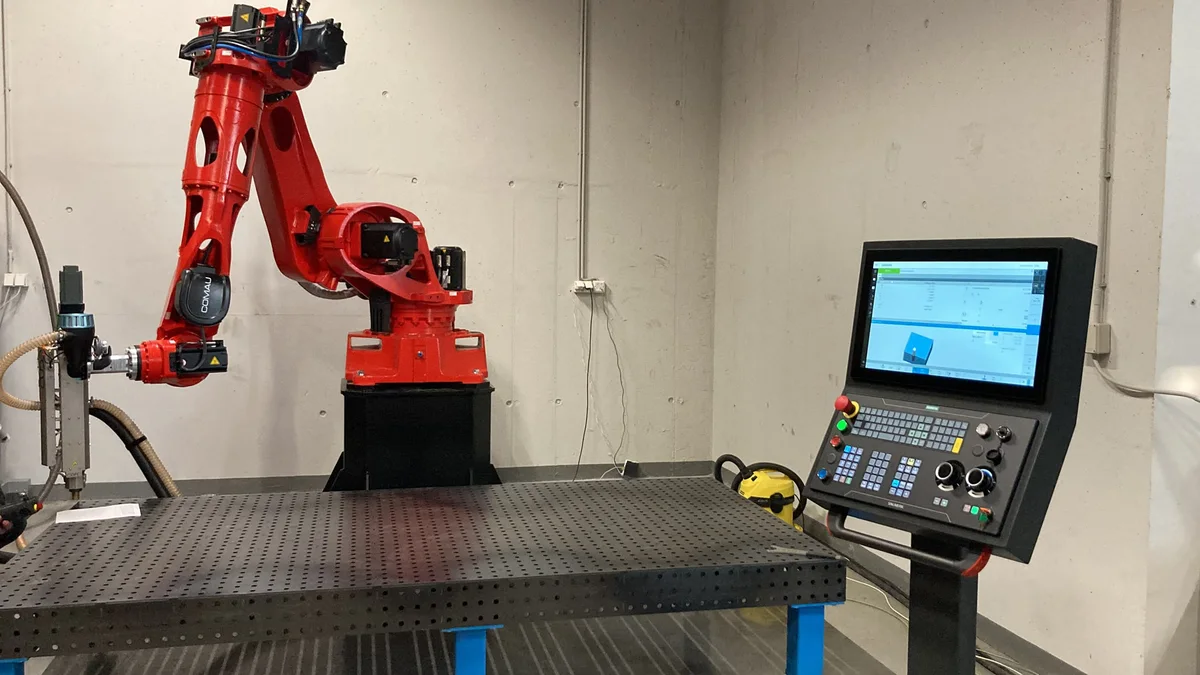
Modular MAWELD welding tables can also provide a work platform for robotic large-format 3D printing. The steel structure and flexible surface provide space for build plates, supports and fixtures according to the design of the specific workstation.
Explore use in 3D printingHave a question about sizes, hole spacing or accessories? Contact the Mateos team, which sells MAWELD tables.
Write an emailMAWELD focuses on welding tables and accessories for metalworking and welding workshops. The workstation is based on a perforated steel plate on which you can support the assembly, position it against stops and secure it before tack welding. The table helps organise work when producing frames, brackets, holders and smaller steel structures. Choosing a workstation therefore starts with the parts you actually make, rather than the largest available plate.
This website explains the system, sizes and clamping options. You can select specific variants, prices and delivery options in the Mateos.sk online shop. For repeated production, it makes sense to prepare a consistent arrangement of stops and fixtures: you can return to the same layout for the next assembly. However, the accuracy of the finished part also depends on measurement, material preparation and the welding procedure.
The designation 16 mm system refers to the hole-based clamping system and its corresponding accessories. It is not the thickness of the worktop plate. When selecting stops, angle brackets or clamping elements, check that they are intended for this system. The diameter alone does not replace checking the particular attachment method, pin length and space beneath the plate.
A welding fixture table lets you arrange fixtures to suit the shape of the assembly. First support and align the parts, then secure them. A clamp must not replace missing support or forcibly straighten a poorly prepared part. Before welding, check the dimensions and access to the joints; fixtures must not obstruct the torch.
Hole spacing is the distance between holes in the work surface. At 50 mm, the grid of points is denser, which can make it easier to position stops for shorter sections and smaller parts. A 100 mm grid is less dense and may be sufficient for larger assemblies if it allows all necessary points to be supported. Both options on the tables described here use a 16 mm system.
Closer hole spacing alone does not guarantee a more accurate weld or a higher load capacity. Fixture design and assembly geometry also matter. Before buying, sketch where the sections will sit, where you need a stop and where access must remain clear. This is the best way to assess whether you will use the closer spacing.
For the verified variants, Mateos specifies S355 steel, a 6 mm thick worktop plate and legs made from 80 × 80 mm sections. These details describe specific published versions; without further documentation, neither the load capacity of the complete assembly nor its flatness tolerance can be inferred. For heavy parts, confirm the required load for the selected model.
The published working height range is 870 to 1 000 mm. Choose the height with the height of the clamped part in mind, as well as the tabletop itself. Leave space for operation and handling at the workstation. Before placing the assembly, check the table's stability and the cleanliness of the support surfaces; dirt beneath a part can affect its position.
The verified range includes sizes such as 1000 × 1000, 1200 × 1000, 1600 × 1000, 2000 × 1000 and 2400 × 1200 mm. A smaller top may suit repeated production of small assemblies, while a longer one offers more room for frames and longitudinal sections. Add space for stops and clamps to the product footprint. A wide top also requires careful planning of reach to the centre.
Assess workshop space together with material flow: the table must not block access to a machine, trolley or door. For an oversized assembly, do not rely on tabletop size alone. Required supports, weight distribution and handling must be addressed separately. The sizes page provides guidance by application and links to specific published products.
Stops determine part positions, angle brackets help create support surfaces and clamps secure the assembly. Choose the number of fixtures according to the number of support and clamping points, rather than table size alone. Check compatibility with the 16 mm system and the specific top. When the product range changes, an adaptable set may be more useful than a single fixed fixture.
Before ordering, prepare a typical drawing or sketch of the assembly, the largest part dimensions and the handling method. This information will help you choose hole spacing, work surface and accessories. If you are unsure of the appropriate version, contact the Mateos team and confirm the parameters of the specific product.
When clamping parts on a perforated table, the positions of supports, stops and clamps are decisive. First sketch a typical assembly and leave room for access to the welds.
| Selection | What to assess for your work | Details |
|---|---|---|
| 50 mm hole spacing | A denser grid of holes for smaller parts and more frequent fixture changes. | Tables with 50 mm hole spacing |
| 100 mm hole spacing | Check that the less dense grid allows every necessary point of the assembly to be supported and secured. | Tables with 100 mm hole spacing |
| Work surface | Add room for fixtures and workshop handling to the part dimensions. | Welding table sizes |